What Is Electrical Resistance? Simple Explanation for Beginners (Water Hose Analogy)
What Is Electrical Resistance? Simple Explanation for Beginners
Electrical resistance is one of the three core concepts in electronics.
If voltage is the push and current is the flow, then resistance is what slows the electrons down.
In this beginner-friendly guide, we’ll use simple analogies to explain exactly what resistance is and why it matters in every circuit.
Electrical Resistance Explained Simply
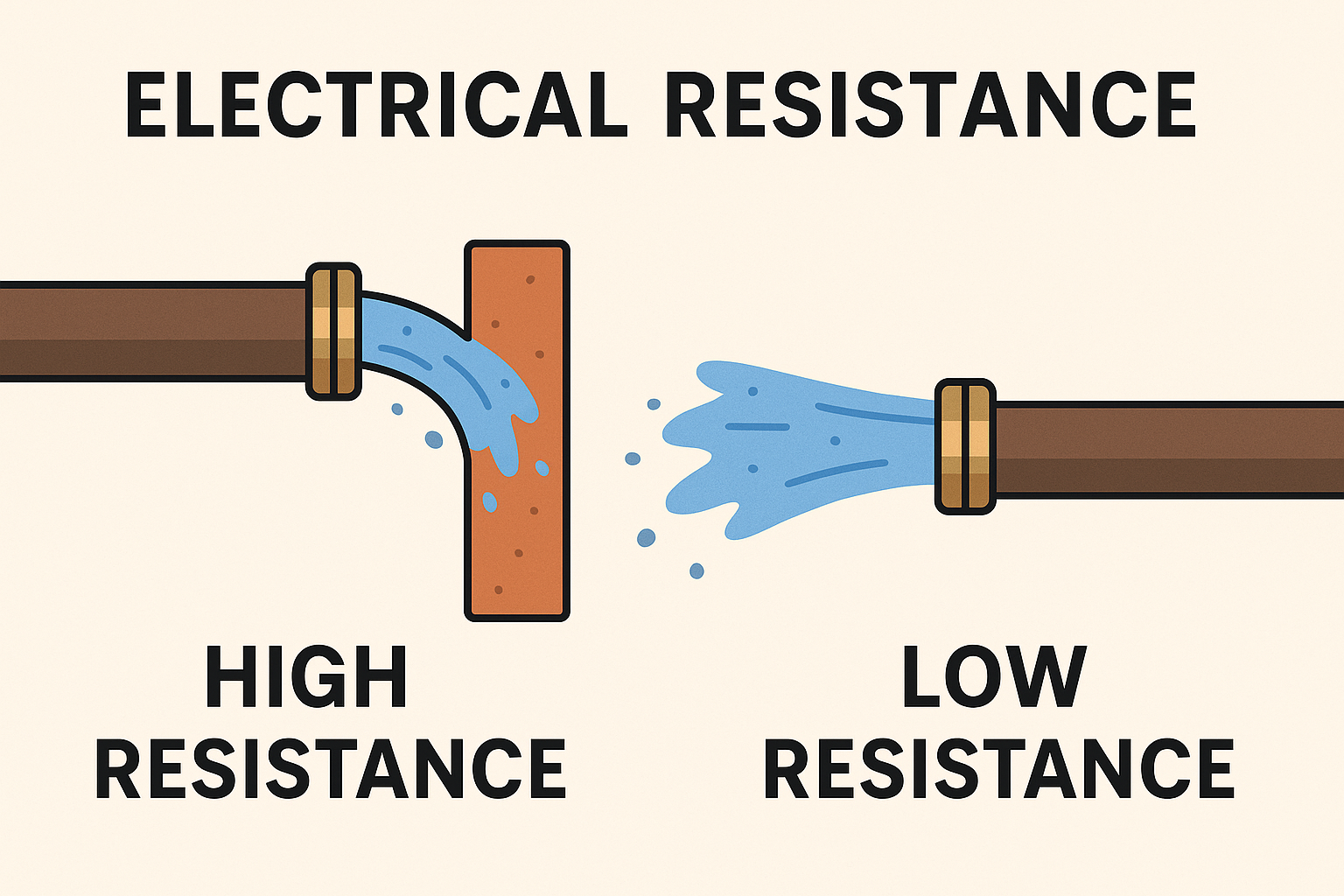
Let’s bring back the garden hose analogy:
- Narrow hose → water struggles → high resistance
- Wide hose → water flows easily → low resistance
Electrical materials behave the same way:
- Copper → low resistance (electrons move easily)
- Rubber → extremely high resistance (electrons barely move)
Resistance is measured in ohms (Ω).
Explained for a 15-Year-Old
Imagine trying to run across different surfaces:
- Smooth floor → easy
- Deep sand → hard
- Mud → almost impossible
That difficulty is just like electrical resistance.
- High resistance = very hard for electrons to move
- Low resistance = easy for electrons to move
This is also why wires are made from copper, not rubber — electrons need an easy path.
Why Electrical Resistance Matters
Resistance affects everything in a circuit:
🔥 1. How much current flows
Higher resistance = less current
🔥 2. How much heat is produced
High resistance can cause components and wires to heat up.
🔥 3. Energy usage
More resistance can mean more energy lost as heat.
🔥 4. Component safety
Every component (LEDs, motors, coils, resistors) has a resistance value that affects how it behaves.
Ohm’s Law (The Most Important Rule)
One simple formula describes the relationship between voltage, current, and resistance:
Voltage = Current × Resistance
V = I × R
This equation is the foundation of all circuit calculations.
1-Minute Test: Check Your Understanding
- Resistance is measured in:
a) volts
b) ohms ✔️
c) amps - Which has lower resistance?
a) copper
b) rubber ❌ (correct answer is copper) ✔️ - What does high resistance do to current?
a) allows more
b) reduces it ✔️
c) has no effect - True or false: resistance can produce heat.
True ✔️ - In Ohm’s law, V = I × R, what does R stand for?
Resistance ✔️
Final Thoughts
Electrical resistance decides how easily current can move, how hot components get, and how safely a circuit operates.
Once you understand resistance — alongside voltage and current — you’re ready to tackle almost any beginner electronics topic.