
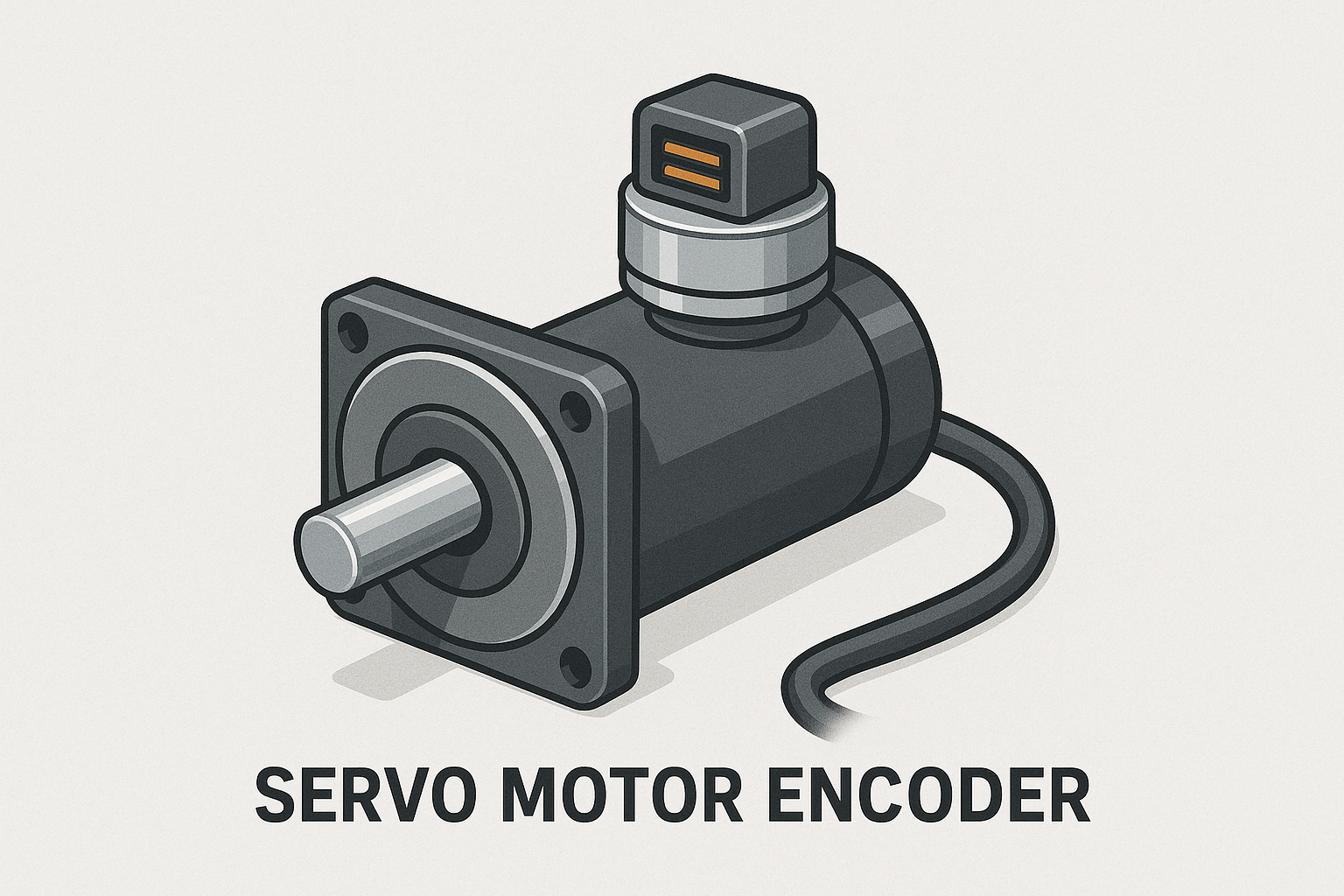
Servo Motor Encoders: A Simple and Clear Guide
Servo systems are everywhere in modern automation — from CNC machines and robotics to packaging equipment and conveyor systems. At the heart of every precise servo motor is one essential component: the encoder.
In this easy-to-understand guide, we’ll explain what servo motor encoders are, why they matter, and how they work, without overwhelming technical jargon.
What Is a Servo Motor Encoder?
A servo motor encoder is a feedback device attached to the motor shaft. Its job is to track:
- Position (where the motor is)
- Speed (how fast it’s moving)
- Direction (which way it’s rotating)
Think of the encoder as the eyes of the servo system. Without it, the controller would be “blind” and unable to move accurately.
Why Encoders Are Important in Servo Motors
Servo motors are used when precise control is needed. Encoders make that precision possible.
They allow the controller to:
- Correct position errors instantly
- Maintain accurate speed
- Achieve smooth, stable motion
- Synchronize multiple axes
- Improve machine safety and reliability
Basically, the encoder ensures the motor does exactly what it’s told, down to fractions of a degree.
How Servo Motor Encoders Work
Encoders generate signals as the motor shaft rotates. These signals are sent back to the servo drive or controller.
Most encoders work using:
- Light and a rotating disk (optical encoders)
- Magnetic fields (magnetic encoders)
As the shaft moves, the encoder creates pulses or digital signals. The controller reads these signals and calculates:
- The shaft’s current position
- How fast it’s turning
- Whether it needs to speed up, slow down, or change direction
This feedback loop is called closed-loop control, and it is what makes servo motors extremely accurate.
Types of Servo Motor Encoders
There are several types of encoders used in servo systems:
1. Incremental Encoders
- Produce pulses as the shaft rotates
- Simple, reliable, and cost-effective
- Good for speed and direction control
Limitation:
They don’t provide an absolute position after power loss — the machine must be “homed” at startup.
2. Absolute Encoders
- Provide a unique digital value for every shaft position
- Keep position information even after power is removed
- No homing required
Benefit:
Excellent for robotics, CNC, and applications requiring precise positioning.
3. Magnetic Encoders
- Use magnetic sensors instead of light
- Resistant to dust, vibration, moisture, and oil
- Durable and ideal for harsh industrial environments
Trade-off:
Slightly lower accuracy than optical types but excellent reliability.
4. Optical Encoders
- Use light passing through or reflecting off a disk
- Very high resolution and accuracy
- Common in high-precision servo applications
Trade-off:
More sensitive to contamination (dust, oil).
Where Servo Motor Encoders Are Used
You’ll find servo motor encoders in almost every motion-control system, including:
- CNC milling and turning machines
- Industrial robots and robotic arms
- Packaging and labeling machinery
- Conveyor and sorting systems
- Automated assembly lines
- 3D printers and pick-and-place machines
Any application that requires precision, speed control, and reliability depends on encoders.
Choosing the Right Encoder
When selecting a servo motor encoder, consider:
- Required accuracy
- Speed of the application
- Environmental conditions
- Mounting style (shafted, hollow, modular)
- Signal type (TTL, HTL, SSI, BiSS)
- Resolution (PPR or CPR)
Matching the encoder to the motor and application ensures maximum performance and long-term stability.
Final Thoughts
Servo motor encoders may be small, but they are absolutely critical to automation. They provide the feedback needed for precise movement, stable operation, and high-quality production.
Whether you’re working with robotics, CNC machines, or any motion system, understanding encoders helps you troubleshoot, upgrade, and design better automation solutions.