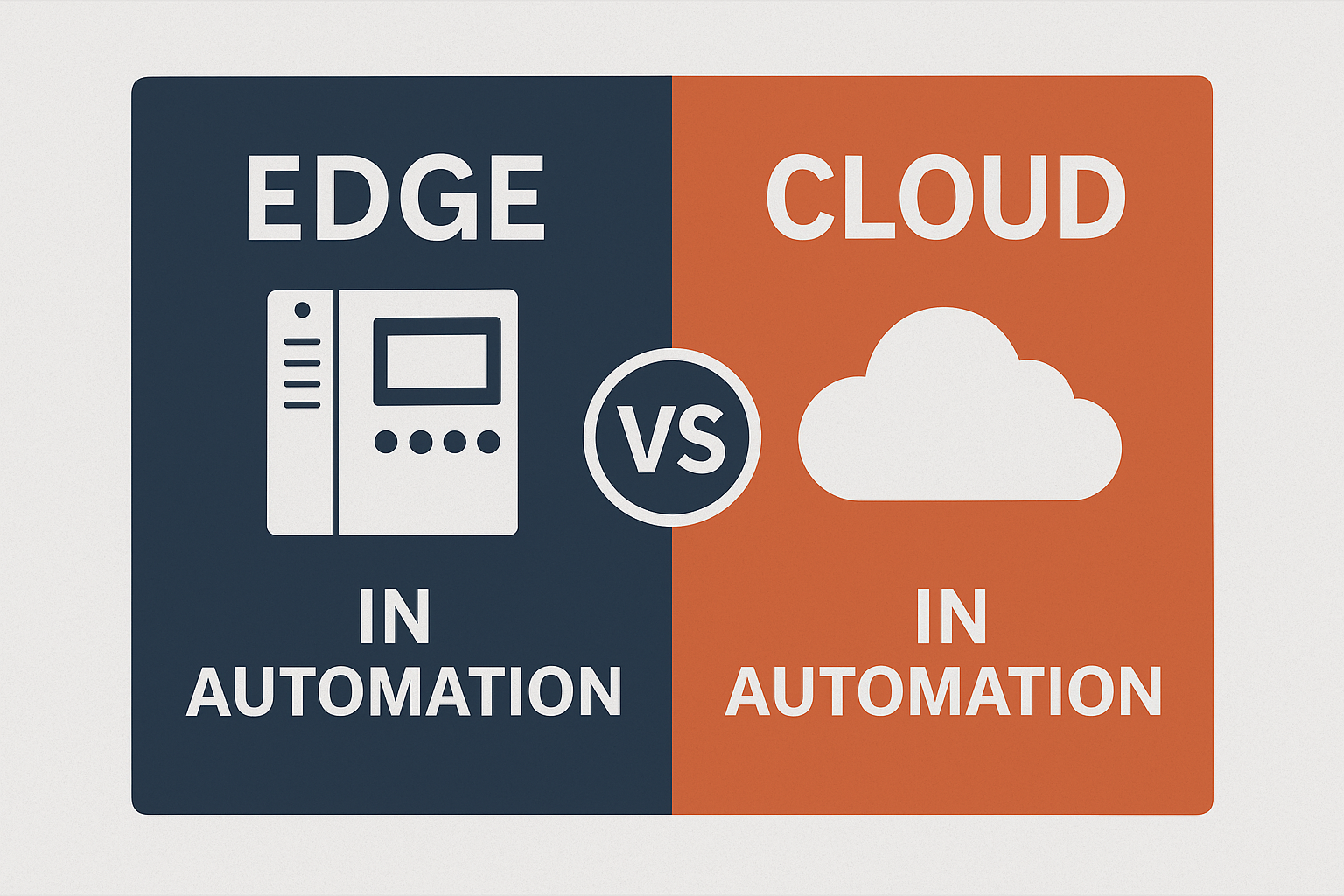
Edge vs Cloud in Automation: Which Architecture Is Best for Modern Industrial Systems?
Edge vs Cloud in Automation: Which One Should You Choose?
As industrial automation systems become more connected and data-driven, one question appears in almost every modernization project:
Should we process data at the edge, in the cloud, or both?
Understanding the difference between edge computing and cloud computing—and when to use each—is critical for designing reliable, scalable, and high-performance automation systems. This guide explains how both technologies work, their advantages, limitations, and the best use cases for modern industrial environments.
What Is Edge Computing?
Edge computing refers to processing data close to the source—at the machine, PLC, robot, sensor, or local gateway.
Examples of edge devices:
- Industrial PCs
- PLCs with built-in analytics
- Edge gateways
- Smart sensors
- Local servers
What edge does best:
✔ Real-time decisions
✔ Low latency
✔ High reliability
✔ Local autonomy during network loss
What Is Cloud Computing?
The cloud refers to centralized remote servers used to store and analyze large volumes of data. Cloud platforms include AWS, Azure, Google Cloud, and specialized industrial clouds like Siemens MindSphere or Rockwell FactoryTalk Hub.
What the cloud does best:
✔ Massive data storage
✔ AI/ML training
✔ Enterprise dashboards
✔ Long-term analytics
✔ Inter-site visibility
Edge vs Cloud: Key Differences
| Feature | Edge | Cloud |
|---|---|---|
| Latency | Very low | Higher |
| Real-time control | Excellent | Not suitable |
| Data storage | Limited | Virtually unlimited |
| Bandwidth usage | Low | High (without filtering) |
| AI/ML | Real-time inference | Large-scale model training |
| Operational continuity | Works without internet | Requires connection |
| Cost | Hardware investment | Subscription & usage fees |
When to Use Edge Computing
1. Real-Time Machine Control
You cannot run motion control, safety systems, or production-critical logic through the cloud.
Edge is the only option.
Examples:
- Robotic arms
- High-speed packaging lines
- CNC machines
- Safety systems
2. Local Pre-Processing and Filtering
Instead of sending raw data to the cloud, edge devices:
- Filter noise
- Compress data
- Detect anomalies
- Only send what matters
This reduces network load significantly.
3. Plants With Limited or Unstable Connectivity
If internet reliability is questionable, the edge ensures that:
- Machines stay running
- Data continues to be collected locally
- Operators retain visibility
When to Use Cloud Computing
1. Large-Scale Storage and Analytics
Cloud platforms handle:
- Multi-year data history
- Global fleet analytics
- Long-term batch trend analysis
Perfect for continuous improvement and high-level decision-making.
2. Enterprise-Level Dashboards
Corporate teams can access cloud dashboards from anywhere.
Use cases:
- KPI reporting
- OEE comparison across plants
- Predictive maintenance analytics
3. AI and Machine Learning
Cloud computing is ideal for:
- Training ML models
- Running simulations
- Large-scale anomaly analysis
These trained models can then be deployed back to the edge for real-time use.
Why Most Modern Plants Use a Hybrid Approach
The most effective architecture today is edge + cloud working together.
Hybrid Automation Benefits
✔ Real-time response at the machine
✔ High-level analytics in the cloud
✔ Reduced bandwidth usage
✔ Enterprise-wide visibility
✔ AI running both locally and centrally
✔ Continuous operation even offline
This hybrid model provides the reliability of local processing with the intelligence of cloud analytics.
Real-World Example: Edge + Cloud in Action
A packaging plant equipped its PLCs and industrial PCs with edge capabilities.
Edge handled:
- Real-time machine control
- Quality checks
- Predictive vibration alerts
- Local dashboards
Cloud handled:
- Multi-line OEE comparison
- AI model training
- Long-term historical records
- Maintenance planning
Result:
15% downtime reduction, better energy management, and unified visibility across the entire site.
Which One Should You Choose?
Choose Edge when:
- You need low latency
- Local safety and control are critical
- Internet reliability is uncertain
- Data doesn’t need to leave the plant
Choose Cloud when:
- You need cross-site access
- Data volume is large
- Long-term storage is required
- AI and analytics are important
Choose Both when:
- You want a scalable, modern architecture
- You need real-time precision + global visibility
- You’re building Industry 4.0 / IIoT systems
Conclusion
Edge and cloud computing are not competitors—they are complementary tools.
Your choice depends on your process requirements, latency tolerance, connectivity, and data needs.
For most plants, the optimal solution is a hybrid edge-cloud architecture that combines real-time control with enterprise-level intelligence.