How to Choose the Right Industrial Protocol for Your Automation System
Choosing the Right Industrial Protocol: A Practical Guide for Modern Automation
Selecting the correct industrial protocol is one of the most important decisions in automation design. The protocol you choose directly affects system performance, data speed, interoperability, scalability, and long-term reliability.
Whether you’re designing a new line, upgrading old controllers, or integrating multiple vendors, this guide will help you confidently choose the right industrial communication protocol.
What Is an Industrial Protocol?
An industrial protocol defines how devices communicate in automation systems. PLCs, HMIs, drives, sensors, and SCADA systems rely on these protocols to exchange real-time data, control signals, and diagnostics.
Different protocols are built for different purposes — some prioritize speed, others reliability, flexibility, or safety.
Key Factors to Consider When Choosing a Protocol
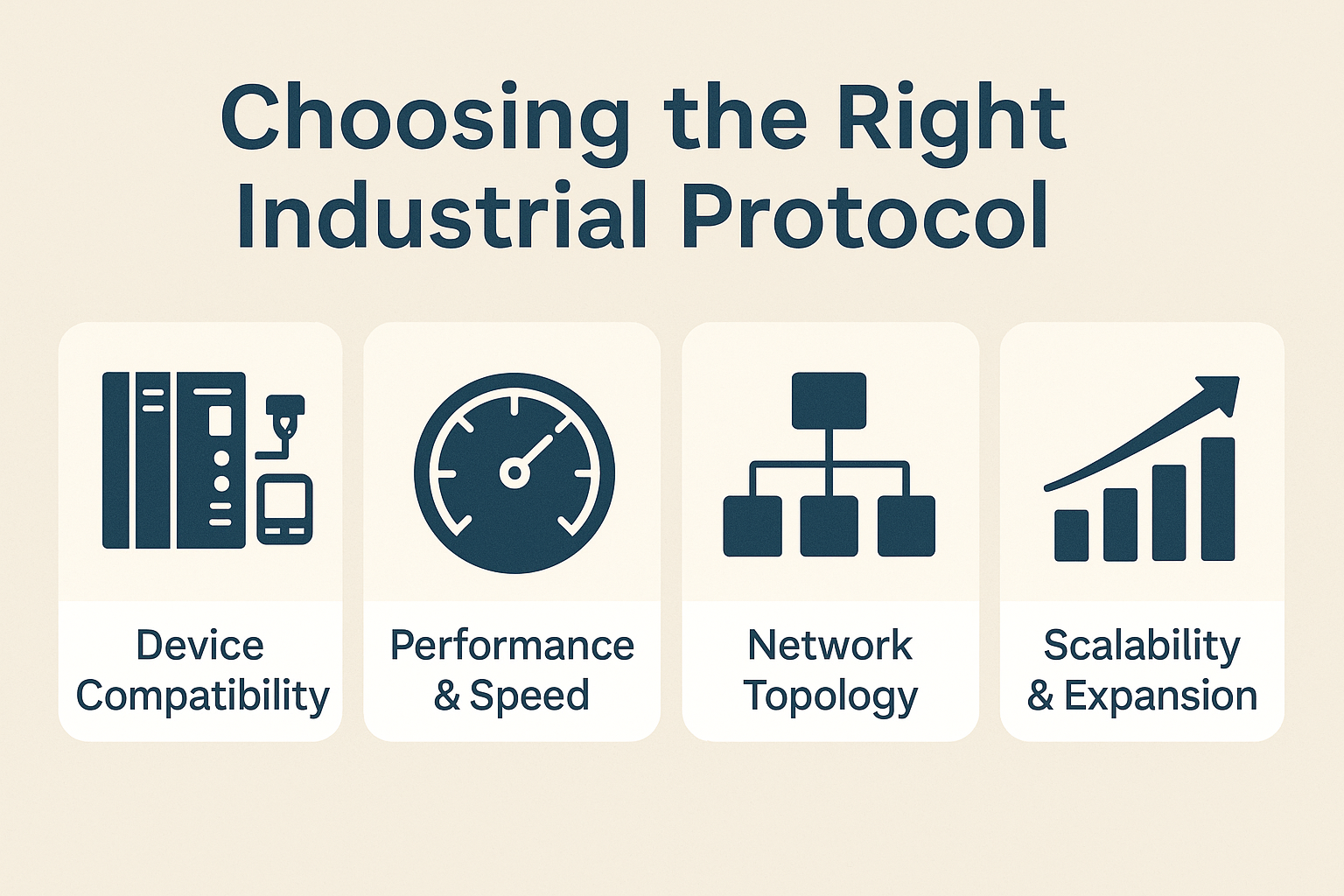
1. Device Compatibility
Start by checking which protocols are natively supported by your hardware:
- PLC brand (Siemens, Rockwell, Omron, Mitsubishi, Beckhoff, etc.)
- Drives and servo systems
- HMIs and SCADA
- Industrial PCs or gateways
Native support reduces costs and setup time.
2. Performance & Speed Requirements
Different processes require different speeds:
| Application | Recommended Protocol Features |
|---|---|
| High-speed motion | Deterministic, low-latency, real-time Ethernet |
| Factory monitoring | Standard Ethernet or serial-based protocols |
| Large data logging | High bandwidth, robust error handling |
Highest-performance options include EtherCAT, PROFINET IRT, SERCOS III.
3. Network Topology
Some protocols support flexible topologies (star, line, ring), while others are limited.
- EtherCAT: line, ring
- EtherNet/IP: star (Ethernet-based)
- Modbus RTU: daisy chain
- PROFIBUS: bus topology
Choose one that matches your plant layout.
4. Scalability & Expansion
Ask yourself:
- Will more devices be added later?
- Will multiple vendors be integrated?
- Will the system expand to IIoT or cloud monitoring?
Ethernet-based protocols (EtherNet/IP, PROFINET, Modbus TCP) scale best.
5. Interoperability
If your plant uses multiple brands, choose a protocol with strong multi-vendor support.
| Protocol | Cross-Vendor Compatibility |
|---|---|
| Modbus (RTU/TCP) | Excellent |
| EtherNet/IP | Excellent |
| PROFINET | Very good |
| EtherCAT | Good but vendor-specific features vary |
| PROFIBUS | Very good |
6. Determinism & Real-Time Control
For motion control or synchronized tasks, determinism matters.
Real-time capable protocols include:
- EtherCAT
- PROFINET IRT
- SERCOS III
Non-real-time (but widely used):
- Modbus TCP
- Standard EtherNet/IP
- OPC UA (non-deterministic but scalable)
7. Safety Requirements
If your system requires safety over the network, look for:
- PROFIsafe (PROFINET)
- CIP Safety (EtherNet/IP)
- FSoE (EtherCAT)
These allow safe shutdowns and emergency stops over communication lines.
Most Common Industrial Protocols (Quick Overview)
1. Modbus RTU / Modbus TCP
- Simple, universal, cost-effective
- Excellent multi-vendor interoperability
- Best for sensors, HMIs, monitoring systems
- Not ideal for high-speed applications
2. EtherNet/IP
- Popular in Allen-Bradley/Rockwell systems
- Strong integration with SCADA and IIoT
- Scalable and widely supported
- Real-time performance varies
3. PROFINET
- Industry standard in Siemens automation
- High performance with real-time IRT mode
- Large vendor ecosystem
- Great balance of speed and usability
4. EtherCAT
- Ultra-fast, low latency
- Excellent for motion control and robotics
- Flexible topology
- Vendor-specific configuration can be complex
5. PROFIBUS
- Older but extremely reliable in industrial environments
- Still widely used in legacy systems
- Limited bandwidth compared to Ethernet-based protocols
6. OPC UA
- Platform-independent
- Designed for SCADA, MES, cloud, and IIoT
- Great for data modeling and analytics
- Not a real-time control protocol
Decision Matrix: Which Protocol Should You Choose?
| Requirement | Best Options |
|---|---|
| High-speed motion | EtherCAT, PROFINET IRT, SERCOS III |
| Multi-vendor compatibility | Modbus TCP, EtherNet/IP |
| Siemens ecosystem | PROFINET, PROFIBUS |
| Rockwell ecosystem | EtherNet/IP, CIP Safety |
| Low cost & simplicity | Modbus RTU/Modbus TCP |
| IIoT/Cloud data | OPC UA, MQTT (via gateway) |
Final Thoughts
Choosing the right industrial protocol is ultimately about matching technical requirements with system constraints. Consider speed, device compatibility, topology, safety, and future scalability.
With the correct protocol, your system becomes more reliable, easier to expand, and far more efficient.